

Professional Boat Detailing at Home: DIY Guide
Table of Contents
- Professional Boat Detailing at Home: What It Really Takes
- Boat Detailing Tools and Supplies You Actually Need
- Boat Detailing Steps: A Complete At-Home Workflow
- Boat Buffing and Polishing for Maximum Gloss
- Boat Interior Cleaning: Upholstery, Carpet, and Mildew
- DIY vs Hiring a Mobile Detailing Pro: Real Costs
- Wastewater Rules, Safety, and Common Detailing Mistakes
- How Often to Detail Your Boat and Keep It Show-Ready
- Frequently Asked Questions
Last Updated: October 14, 2026
Professional Boat Detailing at Home: What It Really Takes
Professional boat detailing at home means restoring and protecting gelcoat, interior, and hardware to a showroom finish with consumer-grade tools, marine-safe products, and a repeatable workflow.
What most guides get wrong is the sequence. Skipping decontamination before polishing traps salt and grit under your pad, and that grit does the damage you were trying to remove.
This guide covers the complete at-home workflow: tools, wash and dry technique, oxidation removal, buffing, interior work, wastewater rules, and when to hire a pro.
Boat Detailing Tools and Supplies You Actually Need
You need far less than the marine aisle suggests: a wash-and-wax solution, spray sealant, microfiber towels, two buckets, a soft wash mitt, a hose with a shutoff nozzle, and a dual-action polisher with foam pads.
The mistake is buying a dozen specialty sprays before owning a proper drying towel. Water spots form in minutes on hot gelcoat, and a cheap towel just smears the minerals.
The 2-Step System That Replaces a Shelf of Products
A two-step system separates cleaning from protection: a wash-and-wax formula that lifts salt, grime, and water spots while leaving a slick finish, then a spray-on ceramic sealer after drying for gloss and protection between full washes.
Dock Candy's Wash + Wax | Seal + Shine Bundle follows exactly that logic: a 32 oz Wash N Shine, a 32 oz Exterior Ceramic Sealer, and a pink microfiber towel for $54.95. The Wash N Shine is safe on gelcoat and marine surfaces, and the Exterior High Gloss Ceramic Sealer handles dockside touch-ups between washes.


| Task | Product Type | Frequency | Notes |
|---|---|---|---|
| Full wash | Wash-and-wax formula | Every 2-4 weeks | Two-bucket method |
| Dockside touch-up | Spray ceramic sealer | After each outing | Spray, wipe, done |
| Oxidation correction | Compound + polisher | Seasonally | Only when chalky |
| Interior wipe-down | Mild cleaner + towel | Monthly | Vinyl and upholstery |
Boat Detailing Steps: A Complete At-Home Workflow
The workflow runs in five stages: prep and shade, wash top-down, dry immediately, correct oxidation if present, then seal. Skipping the dry step causes most water spots; skipping the seal is why a boat looks dull again three weeks later.
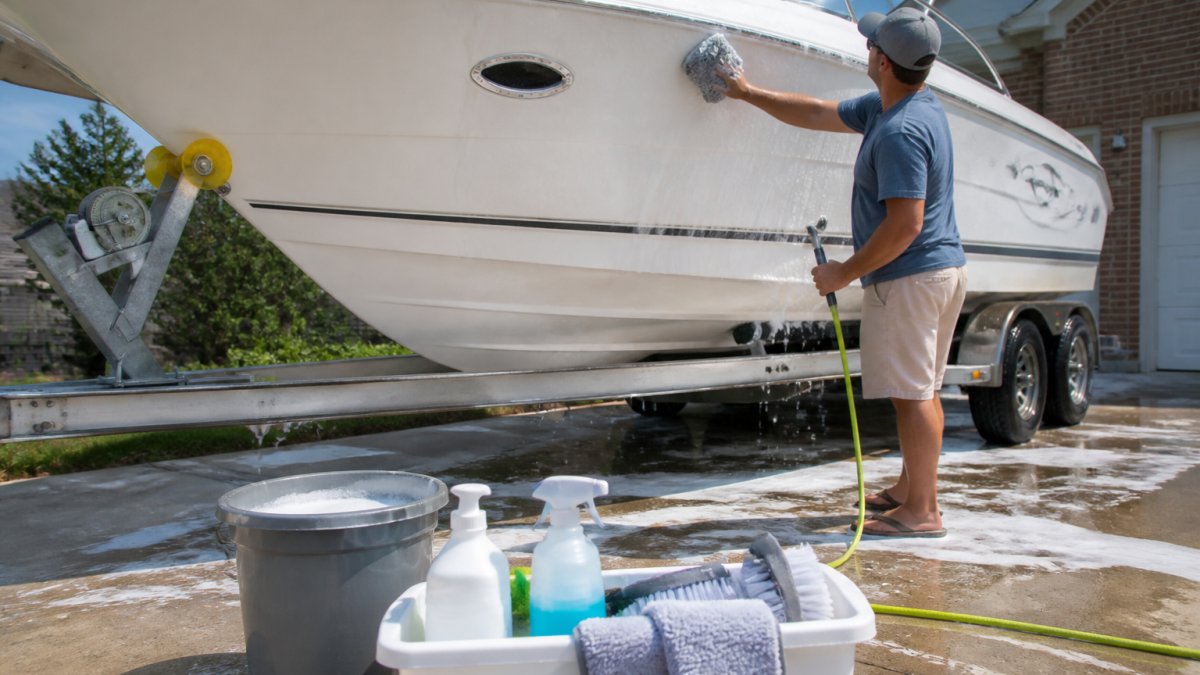
Work in shade or early morning. Gelcoat above roughly 90°F dries wash water before you can rinse, etching minerals into the surface.
Prep, Wash, and Dry Without Water Spots
Rinse the whole boat top down to lift loose grit, then wash in sections using two buckets: one with wash solution, one with clean rinse water for your mitt.
Rinse each section before it dries. For the final pass, remove the nozzle and let water sheet off, then dry immediately with a clean microfiber towel. A drying towel is not optional equipment.
Oxidation Removal and Gelcoat Restoration
Oxidation shows as a chalky, faded film on gelcoat, a surface condition, not permanent damage. Test a small area with compound on a foam pad before doing the whole hull.
Use a dual-action polisher at moderate speed with light pressure in overlapping passes, wiping residue before it dries. Once the chalk is gone, seal the same day, freshly corrected gelcoat has no protection left.
Boat Buffing and Polishing for Maximum Gloss
Maximum gloss comes from preparation, not polish. A clean, decontaminated, oxidation-free surface buffs to a deep reflective finish; a dirty surface just grinds grit into the gelcoat.
Work in small sections, keep the pad flat, and let the machine do the work.
Tape off hardware and non-skid before you start. Buffing residue packed into non-skid texture is miserable to remove later.
Boat Interior Cleaning: Upholstery, Carpet, and Mildew
Interior work is where most boats look neglected, and where the wrong product does permanent damage. Marine interiors mix vinyl, coated polyester thread, carpet, foam, canvas, and acrylic glass, a cleaner safe on one can cloud another. Match the product to the material before spraying.
Match the Cleaner to the Material
- Vinyl seating (marine-grade PVC or expanded vinyl): Use a mild, pH-neutral cleaner and a soft microfiber towel. Avoid solvent-based or high-alkaline degreasers, which pull the plasticizer out of vinyl and leave it stiff and prone to cracking.
- Coated polyester thread and stitching: Stitching is the first thing to fail. Keep cleaners off the seams where possible, and never scrub seams with a stiff brush, the abrasion opens the thread coating and lets water wick into the foam.
- Marine carpet (polypropylene or olefin): The fibers tolerate water well, but the backing and adhesive do not. Extract or blot rather than soak, and pull removable carpet up to dry.
Mildew: Kill It, Then Dry the Space
Mildew on vinyl and carpet signals a boat closed up wet. Treating visible growth is only half the job, spores live in the foam, carpet backing, and seams, and regrow within days if the space stays humid.
- Remove everything loose: cushions, coolers, fenders, lines, and anything stored in lockers.
- Vacuum carpet and seats with a brush attachment to lift dry spores before they get wet and smear.
- Treat affected areas with a mildew cleaner formulated for marine vinyl or fabric, and let it dwell per the label, usually several minutes, not seconds.
- Wipe with a clean, damp microfiber towel, then wipe again with a dry towel.
- Leave hatches, lockers, and the console open, and run a fan or dehumidifier if you can. Airflow is what actually stops the regrowth.
Carpet, Floors, and the Order of Operations
Work top-down inside as you do outside: overhead surfaces, then seats, then carpet and sole last. On non-skid decks, use a soft brush and mild soap; abrasive pads dull the texture and trap residue.
For carpet, blot stains from the outside in and avoid over-wetting. A wet-vac pulls most moisture out of glued-down carpet; removable carpet should be dried flat in the shade, since direct sun can shrink or warp some backing.
Dock Candy Wash + Wax | Seal + Shine Bundle + FREE Towel →
Drying Is the Whole Game
The biggest mistake is cleaning thoroughly, then closing the boat up wet. Trapped moisture grows mildew back within days, and no product prevents that alone. Budget 30 to 60 minutes of open-air drying after an interior clean, longer in humid conditions, and leave a moisture absorber in closed lockers.
DIY vs Hiring a Mobile Detailing Pro: Real Costs
Most guides either sell you a service or a product. The honest answer: some detailing tasks are safe to do yourself, and a few are worth paying a professional for.
The Decision Framework
Three factors drive the call: boat size, oxidation severity, and where the boat lives.
- Boat size. Under about 25 feet, a full wash-and-seal is a comfortable half-day DIY job. Between 25 and 35 feet, expect a full day. Above 35 feet, hiring out at least the correction and coating usually wins, because labor hours compound fast.
- Oxidation severity. Light chalk that wipes off on your hand is a DIY compound-and-polish job. Heavy, crusted oxidation that has dulled gelcoat to flat white is machine-correction work, where an inexperienced hand with a rotary polisher burns through thin gelcoat on edges, rub rails, and cleats.
- Where the boat lives. A trailered boat in a driveway is the easiest DIY scenario. A boat in a slip at a marina often cannot be washed on-site at all, because many facilities restrict water use, soap, and runoff, which is exactly the situation mobile detailers are built for.
Task-by-Task: What to Do Yourself and What to Hand Off
| Task | DIY-friendly? | Why |
|---|---|---|
| Routine wash and dry | Yes | Low risk, high frequency, no special equipment |
| Dockside spray sealant | Yes | Minutes per outing, no machine required |
| Interior wipe-down and vacuum | Yes | Mild products, hand work |
| Mildew treatment | Usually | Safe if you follow label directions and dry thoroughly |
| Light oxidation removal | Sometimes | Doable with a dual-action polisher and light pressure |
| Heavy gelcoat correction | Often no | Risk of burn-through, requires experience and inspection |
| Ceramic coating application | Often no | Surface prep and cure conditions are unforgiving |
| Bottom cleaning and hull work | No | Safety, environmental rules, and specialized gear |
What DIY Actually Costs You
DIY is cheaper in dollars but more expensive in hours. A full detail on a 25-foot boat runs four to six hours of hands-on time, mostly prep, drying, and cleanup.
Equipment is modest if you buy deliberately: a dual-action polisher, foam pads, compound, a wash-and-wax formula, a spray ceramic sealer, two buckets, a soft wash mitt, a hose with a shutoff nozzle, and quality microfiber towels.
What a Mobile Detailer Actually Brings
A mobile detailer arrives with water, power, insurance, and equipment, working at your slip or driveway. Pricing scales with boat length and how much correction the gelcoat needs. Confirm two things before anyone touches your hull:
- Proof of insurance. Ask for a certificate of insurance before work begins. Gelcoat burn-through and damaged hardware are expensive to fix, and an uninsured operator is a problem you do not want.
- On-site permissions. Confirm the provider is allowed to work at your marina. Many facilities restrict water use, soap, and runoff, and some require the marina's own approved vendors.
The Hybrid Approach Most Owners Land On
The pattern that works best is to split the work. Handle routine washes, dockside spray sealant, and interior wipe-downs yourself, low-risk, high-frequency tasks where DIY saves the most. Hire out one seasonal correction and coating per year, when gelcoat needs machine work and prep has to be right.
That split keeps the boat looking detailed year-round without turning every other weekend into a project, and puts professional hours where they change the outcome.
Wastewater Rules, Safety, and Common Detailing Mistakes
Wash water is regulated, which catches owners off guard. Many states and municipalities prohibit wash water from entering storm drains, since it carries soap, oil, and heavy metals straight to waterways untreated. Check with your state environmental agency or marina office before washing on a driveway, and use containment where required.
Safety matters too. Compounds and mildew treatments irritate skin and eyes, so wear gloves and eye protection, and never mix cleaning chemicals.
The mistakes we see most often:
- Washing in direct sun, which bakes water spots into the gelcoat
- Using household dish soap, which strips wax and dries out vinyl
- Buffing before decontaminating, which grinds grit into the finish
How Often to Detail Your Boat and Keep It Show-Ready
A full detail twice a year plus a wash every two to four weeks keeps most boats in good shape.
Between full details, a spray ceramic sealer after each outing handles light water spots, dust, and fingerprints in minutes, the difference between a boat that looks detailed year-round and one that looks tired by midsummer.
The Dock Candy Premium Microfiber Towel and the two-step bundle give you a complete clean, shine, and protect routine without a cabinet full of products.
Frequently Asked Questions
What is a boat detail, and what does a professional boat detail include?
A full boat detail covers interior and exterior cleaning, oxidation removal, buffing, polishing, waxing or sealing, and surface protection. Professional services typically wash and dry by hand, treat gelcoat, clean upholstery and carpet, remove mildew, and apply a marine-grade coating. Doing it at home follows the same order, just at your own pace. A two-step wash-and-seal system can handle most of the exterior work without a shelf of separate products.
What tools do you need to detail a boat at home?
You need a wash mitt or soft brush, two buckets, a hose, a microfiber drying towel, and a quality boat wash and wax. For deeper work, add a dual-action polisher, foam pads, and a ceramic sealer. Dock Candy's Wash + Wax and Seal + Shine Bundle includes Wash N Shine, Exterior Ceramic Sealer, and a pink microfiber towel for $54.95, covering the core exterior steps. Interior cleaning needs a mild cleaner, soft brush, and shop vacuum.
How much does it cost to buff and polish a boat?
Hiring a mobile detailing pro for buffing and polishing often runs $20 to $50 per foot for a full exterior job, so a 25-foot boat can cost $500 to $1,250. At home, you control that cost. A dual-action polisher and pads are a one-time buy, and a boat wash and wax like Dock Candy Wash N Shine is $29.50. The trade-off is your time, usually four to eight hours for a full detail.
Can you apply ceramic sealer to a boat yourself?
Yes. A spray-and-wipe ceramic sealer like Dock Candy Exterior High Gloss Ceramic Sealer is made for DIY use. Wash and dry the boat first, then spray the sealer onto a clean section and wipe it with a microfiber towel until it flashes clear. Work in small sections and out of direct sun. Reapply every few weeks or after heavy use to keep the gloss and protection strong.
How long does it take to detail a boat at home?
A basic wash and seal on a 22-foot boat takes about two to three hours. A full detail with oxidation removal, buffing, polishing, interior cleaning, and sealing can run six to eight hours, or a full weekend for larger boats. Splitting the work across two days keeps it manageable. Recurring maintenance washes every two to four weeks cut the time on each full detail.
How often should you wash and detail a boat?
Wash your boat every two to four weeks during the season, and after every saltwater trip. A full detail with polishing and sealing fits best twice a year, typically at the start and end of the season. Boats kept in a slip or exposed to salt year-round need more frequent sealing. A quick spray-and-wipe with a ceramic detail spray between washes keeps the finish slick.
Keeping a boat show-ready is a maintenance habit, not a once-a-season project. Dock Candy makes it simple with a two-step system built around a powerful Wash N Shine cleaner and a high-gloss ceramic Exterior sealer, plus a premium pink microfiber towel in the bundle and free shipping on bundle orders. Get started with Dock Candy and keep your boat looking freshly detailed every time you pull into the dock.