

How to Clean Salt From Boat Hull: Step-by-Step
Table of Contents
- Why Salt Cleanup Matters for Your Boat Hull
- What You'll Need Before You Start
- Step 1: Rinse With Fresh Water After Saltwater Use
- Step 2: Remove Loose Salt Deposits and Grime
- How to Remove Salt Stains From a Boat Hull
- Best Boat Hull Cleaner for Salt and Buildup
- How Often to Wash a Boat After Saltwater Use
- Prevention: Keep Salt Buildup From Starting
- Frequently Asked Questions
Last Updated: October 16, 2026
Why Salt Cleanup Matters for Your Boat Hull
Salt deposits are relentless. If you keep your boat in saltwater, white crusty buildup appears within days, and left untouched it eats into your hull's protective layers and causes permanent damage.
The real problem is that most boat owners wait too long. By the time they notice heavy buildup, the salt has bonded to the gelcoat and a quick rinse won't cut through it.
Consistent cleaning prevents expensive repairs, keeps your hull looking sharp, and protects structural integrity.
The good news is that how to clean salt from boat hull doesn't have to be complicated. With the right approach and tools, you can remove salt deposits effectively and keep your boat looking pristine.
What You'll Need Before You Start
Gather these items before you begin cleaning:
- Fresh water source (garden hose with adequate pressure)
- Soft-bristle brush (avoid wire brushes that scratch gelcoat)
- Boat wash soap or marine cleaning solution (dish soap works in a pinch, but marine-specific formulas are gentler)
- Spray bottle or pump sprayer (for applying cleaner without wasting water)
- Microfiber towel (for drying and buffing)
- Bucket (for mixing cleaning solution if needed)
- Safety gear (gloves and eye protection, especially when using acidic cleaners)
For stubborn salt stains, you may also want:
- Vinegar-based cleaner (white vinegar diluted with water for light stains)
- Specialized salt remover (formulated to dissolve mineral deposits)
- Ceramic sealer (to protect your hull after cleaning)
Having everything ready means you won't interrupt the process halfway through. The Dock Candy Wash N Shine cleaner cuts through salt and grime in one step.

Step 1: Rinse With Fresh Water After Saltwater Use
Start your salt cleanup immediately after returning from the water. Fresh water is your first line of defense against salt buildup.
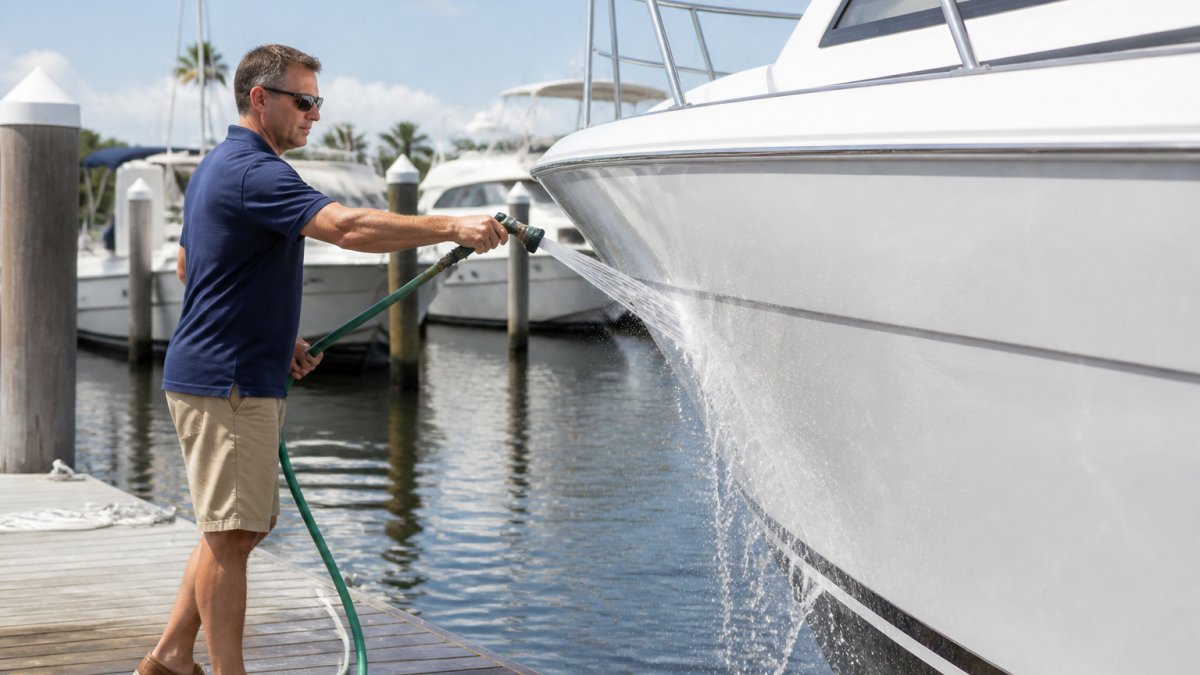
Spray the entire hull with steady pressure, focusing on the waterline where salt accumulates most heavily.
Fresh water dissolves salt crystals before they dry and bond. Wait even a few hours and dried salt becomes much harder to remove, the sooner you rinse, the less scrubbing you'll need later.
Don't skip this step thinking a thorough wash later will handle it, dried salt becomes stubborn mineral stains, and a quick rinse right after use prevents that entirely.
Step 2: Remove Loose Salt Deposits and Grime
After your initial fresh water rinse, address any loose salt residue still clinging to the hull.
Use a soft brush in circular motions, focusing on areas where salt pools, around railings, along the waterline, and near deck fittings. Rinse with fresh water as you scrub to wash away loosened particles.
For light residue this step alone may be enough; for heavier buildup, move to the washing phase. The key is removing what you can without aggressive scrubbing, which damages gelcoat.
Many owners jump straight to heavy scrubbing, which wastes effort and risks scratching the hull. Two gentle passes with a soft brush work better than one aggressive scrub.
How to Remove Salt Stains From a Boat Hull
Dried salt stains have bonded to the hull surface and need proper cleaning to break down.
Scrub gently with your soft brush using circular motions. Don't press hard, let the soap do the work.
For stubborn stains, mix equal parts white vinegar and fresh water in a spray bottle. The acidity dissolves mineral deposits: spray, let sit 5 minutes, scrub lightly, and rinse well.
Be cautious with acidic cleaners on sensitive hull materials. Test any new cleaner on a small, inconspicuous area first, since some surfaces react differently to acids.
After removing salt stains, your hull may look dull. The Dock Candy Wash N Shine formula cuts through salt buildup while restoring shine.
Dock Candy Wash N Shine – Premium Boat Wash & Wax →
Best Boat Hull Cleaner for Salt and Buildup
The right cleaner depends less on how much salt you have and more on what your hull is made of. The wrong product causes etching, fading, or corrosion that costs far more to fix than the salt ever would.
Match the cleaner to the hull material
| Hull material | Safe everyday cleaner | Use with caution | Avoid |
|---|---|---|---|
| Fiberglass with gelcoat | pH-neutral marine wash soap | Diluted white vinegar (1:1 with water) for water spots | Muriatic acid, undiluted vinegar, abrasive powders |
| Painted hull (topsides) | pH-neutral marine wash soap | Mild car wash soap | Solvent-based degreasers, strong acids |
| Bare aluminum | Aluminum-safe marine wash | , | Any acid, bleach, or ammonia-based cleaner |
| Stainless steel fittings | Fresh water plus mild soap | Vinegar for light mineral film | Chlorine bleach (pitting risk) |
| Teak or wood trim | Teak cleaner made for the purpose | , | Household bleach, pressure washing |
Many owners reach for dish soap because it's on hand. It works, but many dish soaps strip wax and leave a film that attracts new grime; marine wash soaps lift salt without stripping the protective layer underneath.
Dilution and dwell time that actually work
- Marine wash soap: follow the bottle ratio, typically 1 oz per gallon of water. Apply, let dwell 2 to 3 minutes, agitate with a soft brush, rinse until the runoff runs clear.
- White vinegar for light mineral spots: mix 1 part white vinegar to 1 part fresh water. Spray, dwell no more than 5 minutes, scrub lightly, rinse thoroughly. Do not let it dry on the surface.
- Specialized salt removers: use the label dilution exactly. More concentrate is not better, it is how gelcoat gets dulled.
Safety and test-spot protocol
Before any new cleaner touches the whole hull:
- Pick a small area below the rub rail or near the transom where a mistake will not be seen.
- Apply the diluted cleaner, let it dwell the full recommended time, and rinse.
- Wait 24 hours and inspect for dulling, hazing, or color shift.
- Only then apply to the full hull.
Wear nitrile gloves and eye protection whenever you handle an acidic or specialized salt remover. Work in shade when possible, cleaners dry faster and act more aggressively in direct sun.
What each product type is actually for
- pH-neutral marine wash soap: everyday salt removal on gelcoat and paint. The default choice.
- Wash-and-wax or wash-and-seal formulas: same job, but they leave a slick layer that makes the next rinse easier. Good for owners who want one step.
- Vinegar solutions: light water spots and thin salt film. Not strong enough for crusted deposits.
- Specialized salt removers: heavy, dried, or long-standing mineral buildup. Treat these as a periodic tool, not a weekly wash.
If you are unsure what your hull is finished with, start with the mildest option, pH-neutral soap and fresh water, and escalate only if the salt does not lift.
How Often to Wash a Boat After Saltwater Use
Washing frequency depends on how often you use your boat and where it's stored, more time in saltwater means more frequent cleaning.
Weekly washing is ideal if you use your boat multiple times per week in saltwater, preventing salt from accumulating to problematic levels.
Bi-weekly washing works if you use your boat once or twice weekly, preventing heavy buildup while allowing flexibility.
Monthly deep cleaning suits boats that sit in saltwater year-round but aren't used often, even inactive boats need regular attention to prevent salt damage.
Beyond regular washing, apply a protective sealer every 3 to 6 months. A ceramic sealer like the Dock Candy Exterior adds a high-gloss protective finish and serious shine.

The best frequency depends on your situation: high-salt environments need more attention than brackish water, and strong sun and heat make salt accumulate faster.
Prevention: Keep Salt Buildup From Starting
Prevention is not one habit, it is a short routine tuned to how you use the boat and what the hull is made of. The table below is the baseline; the notes after it explain how to adjust.
| Prevention method | Frequency | Time required | Why it works |
|---|---|---|---|
| Fresh water rinse after every saltwater trip | After each use | 10-15 minutes | Dissolves salt before it crystallizes and bonds |
| Full wash with marine soap | Weekly to monthly, based on use | 30-45 minutes | Removes salt film the rinse leaves behind |
| Protective sealer or wax | Every 3-6 months | 20-30 minutes | Creates a slick barrier that sheds salt and makes rinsing faster |
| High-risk spot check (railings, fittings, waterline) | Weekly | 5 minutes | Catches pooling salt before it becomes a stain |
| Off-season cover and periodic rinse | Monthly when stored | 15 minutes | Prevents salt spray and dust from baking onto the surface |
A staged method for hulls with long-term buildup
If the hull has gone months without attention, a single wash will not fix it. Work in stages and give the chemistry time to act:
- Soak, do not scrub. Wet the hull with fresh water and let it sit 10 minutes to soften the crust.
- Apply diluted marine soap or a salt remover and let it dwell the full label time.
- Agitate with a soft brush, working top to bottom so dirty runoff does not recontaminate clean areas.
- Rinse and inspect. If white or chalky residue remains, repeat the dwell-and-rinse cycle rather than scrubbing harder.
- Repeat up to three cycles before escalating to a specialized remover. Aggressive scrubbing on the first pass is what dulls gelcoat.
Tell salt apart from other stains
Not every white mark is salt. If a stain survives two wash cycles, it is probably something else:
- Chalky white film that wipes off with a finger: salt residue, a rinse and wash will handle it.
- Dull, powdery surface that does not wipe off: oxidation of the gelcoat, needs polishing, not more soap.
- Brown or rust-colored streaks below fittings: metal staining from stainless or hardware, treat with a targeted stain remover, not salt cleaner.
- Hard, ring-shaped mineral deposits at the waterline: mineral scale, a diluted acid product or specialized remover, with a test spot first.
When a stain resists washing, polishing, and a targeted remover, that is the point to consult a professional detailer rather than keep escalating chemicals.
Adjust the schedule to your situation
- Boat kept in a slip year-round: rinse after every outing and wash weekly during heavy-use months.
- Boat trailered and used a few times a month: rinse after each trip and wash every two to four weeks.
- Boat stored on a lift or in a covered slip: rinse after use and wash monthly; the cover reduces but does not eliminate salt spray.
- Boat stored in a high-sun, high-heat area: salt dries faster and bonds harder, so shorten the interval between rinses.
Consistency beats intensity. A 15-minute rinse after every trip prevents the heavy scrubbing that damages gelcoat later.
Frequently Asked Questions
What dissolves salt buildup on a boat hull?
Fresh water is the first line of defense, it rinses away loose salt deposits before they dry and bond to the hull. For stubborn, dried salt stains, a boat-specific wash with mild acidic properties works best. Dock Candy Wash N Shine cuts through salt, grime, and water spots in one step, leaving a protective high-gloss finish. Always dilute any acidic cleaner properly and test on a small area first to ensure it's safe for your hull material.
Can salt damage a boat hull if it is not rinsed off?
Yes. Salt left on your hull accelerates oxidation, causes water spotting, and can etch gelcoat over time. In saltwater environments, salt residue bonds to the surface and becomes harder to remove the longer it sits. Regular rinsing with fresh water after each saltwater trip prevents this damage. A protective sealer applied after washing adds an extra barrier against salt and UV damage.
How often should you wash a boat after using it in saltwater?
Rinse with fresh water immediately after every saltwater outing, this is non-negotiable. A full wash with soap and cleaner should happen at least once a month during saltwater season, or every two weeks if your boat sits at a marina in heavy salt exposure. The Dock Candy two-step system makes monthly maintenance fast and effective: Wash N Shine cuts through salt buildup, and the Exterior Ceramic Sealer locks in protection.
What is the best homemade boat hull cleaner for salt?
A simple mix of warm water and mild dish soap removes light salt residue and everyday grime. For stubborn salt stains, some boaters use a diluted white vinegar solution (1 part vinegar to 3 parts water), but test it first on an inconspicuous area, acidic cleaners can damage certain hull materials. For reliable, proven results without guesswork, a marine-grade cleaner like Dock Candy Wash N Shine is formulated specifically for salt, is safe on gelcoat, and delivers shine in one step.